Accountability Series | Story 1: Carolyn Presnell
December 18, 2025
In our recent post, Why Accountability Programming Matters Now, our CEO, Amy King, explored the fears and misunderstandings that often surround accountability-based program models—and why they’re needed more than ever. She laid out a clear, ethical framework for building programs that actually help people grow rather than punish them.
But Amy didn’t develop these beliefs in a boardroom; she learned them from people—real people—whose lives were transformed because someone paired structure with compassion at exactly the moment they needed it. Their experiences show that accountability isn’t about control; it’s about connection, stability, and the belief that change is possible.
In this four-part series, we want to share some of those stories with you. They’re powerful reminders that this work isn’t simply about systems or models. It’s about human beings, each with a history, a struggle, and a future worth investing in.
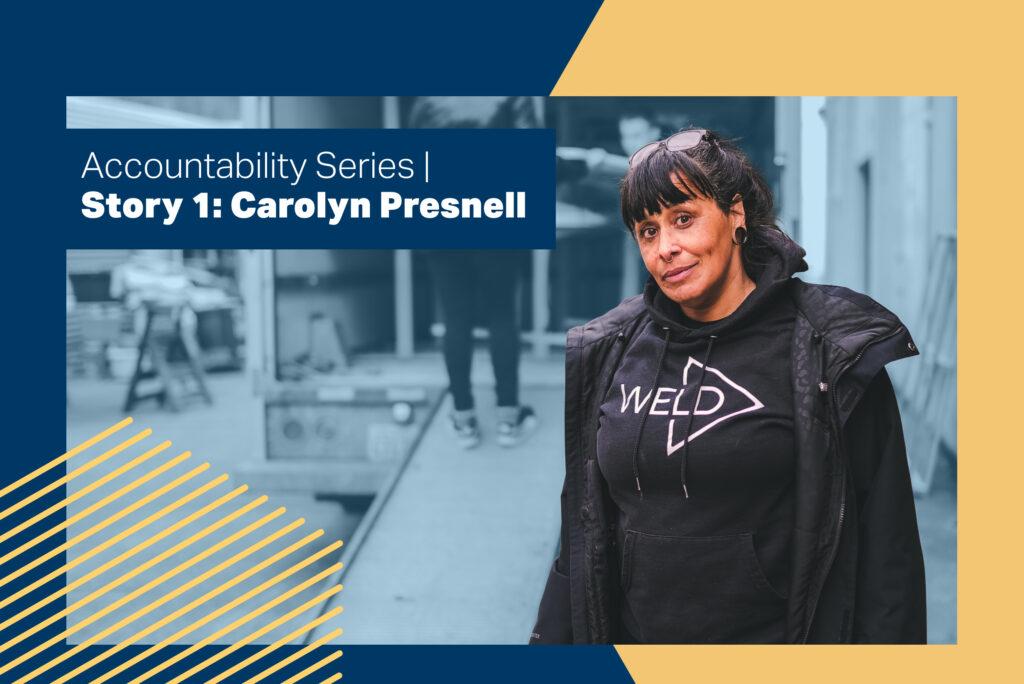
Accountability Series | Story 1: Carolyn Presnell: 1426 Program Director for Weld Seattle
I didn’t find accountability programming because I was out looking for it. It existed, but not in ways that reached people like me - people who were chronically homeless, in and out of the carceral system, deeply addicted, and living lives shaped by trauma, violence, and isolation. My life kept crashing into the same walls: prisons, hospitals, overdoses. I couldn’t go to treatment and then leave with no home to return to, and I couldn’t get housing from treatment because I had no money. I couldn’t make money while actively addicted, because anything I earned went straight back into drugs. I was trapped in a cycle that fed itself - addiction leading to criminal behavior, criminal behavior leading to incarceration, and incarceration becoming the only interruption strong enough to halt the spiral. Over time, I didn’t know how to be accountable to anything because my life had been lawless for so long. It’s an absurd tragedy that incarceration is often the only “resource” available to interrupt trauma and addiction, yet in that forced pause, I finally gained enough clarity to see the destruction of my lifestyle and the possibility of something different. Still, very little about prison is designed for healing; it collects a debt, but it doesn’t rebuild a life.
What rebuilt mine was a network of community supports. Transitional housing, treatment, recovery communities, peer support, mental health services, and reentry case management were all essential for someone with needs as high and complex as mine. I needed accountability, but also safety and a place to experience both wins and losses without being thrown away. The truth is, the community resource cost to stabilize me in those first couple of years was significant. But that investment worked. I haven’t needed those intensive services in almost eight years. That is a dramatic shift from the crisis-driven pattern I lived in for more than three decades of addiction, homelessness, and incarceration.
My perspective on how to achieve transformative outcomes comes directly from what saved my life: accountability paired with community, compassion, safety, and being surrounded by people who shared a real belief that people can change. That good enough was just a placeholder waiting for great to arrive. My work with WELD, combined with that broader community network, didn’t just interrupt my cycle. It gave me the foundation and connection I needed to build an entirely different life. It offered me purpose, a way to make amends, a way to interrupt the cycle in my family and a community where I could grow, contribute, and finally feel like I truly belonged.
Read parts 2,3, and 4 of this series here: Joe's story, Dave's story. Sarah's story
Read the original blog from our CEO, Why Accountability Programming Matters Now