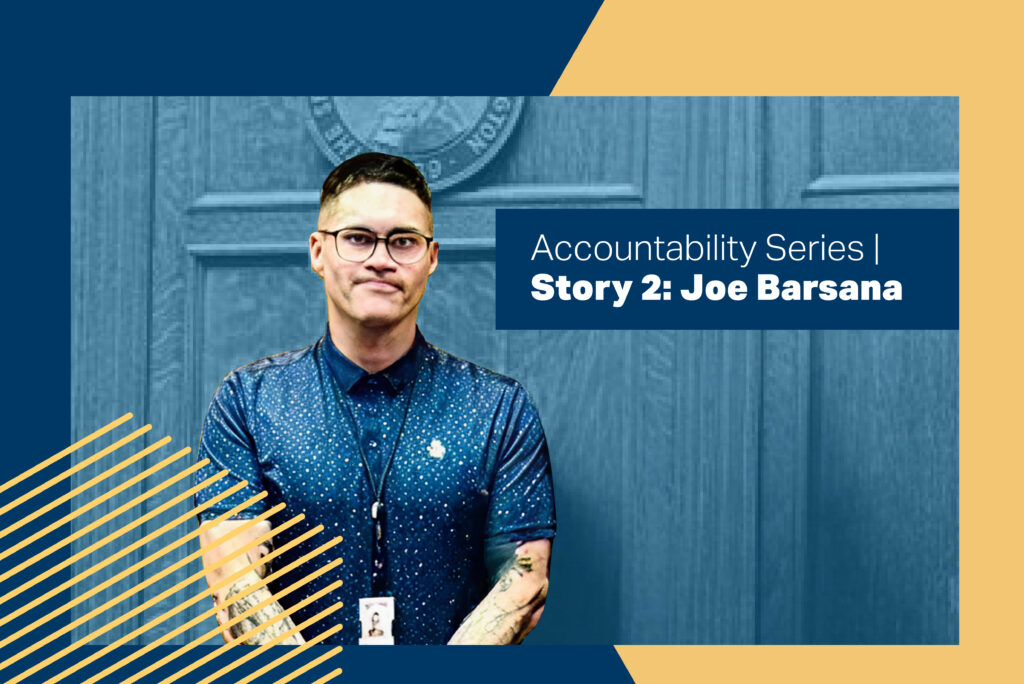
Accountability Series | Story 2: Joe Barsana
December 22, 2025
In our recent post, Why Accountability Programming Matters Now, our CEO, Amy King, explored the fears and misunderstandings that often surround accountability-based program models—and why they’re needed more than ever. She laid out a clear, ethical framework for building programs that actually help people grow rather than punish them.
But Amy didn’t develop these beliefs in a boardroom; she learned them from people—real people—whose lives were transformed because someone paired structure with compassion at exactly the moment they needed it. Their experiences show that accountability isn’t about control; it’s about connection, stability, and the belief that change is possible.
In this four-part series, we want to share some of those stories with you. They’re powerful reminders that this work isn’t simply about systems or models. It’s about human beings, each with a history, a struggle, and a future worth investing in.
Accountability Series | Story 2: Joe Barsana: Housing Case Manager, KCCDC
My time in drug court showed me that accountability is not about punishment, it is about empathy, trust, and growth. Accountability programming gave me structure, but more importantly, it gave me people I could rely on. It meant being honest with myself and with others and learning to trust the support circle around me. Without accountability, I spent years on the streets on Pac Highway and the Blade in downtown Seattle, living in chaos and close to death. Most of my time before drug court was spent incarcerated in punitive systems that did not allow me to grow. Drug court was different; it gave me the chance to change through support, responsibility, and compassion.
Accountability is a vital part of recovery and reintegration because it creates a safe environment where people can rise to their fullest potential. It is not about control; it is about encouragement. Having others stand with you and support your commitments creates trust, confidence, and resilience. Accountability programming reminded me that compassion and responsibility go hand in hand, and that real growth happens when both are present. Today, I have the privilege of working in drug court, the very same program that saved my life. I would not be a success story, working with others like me, if I had not had my support system holding me accountable. That accountability gave me extra layers of support and helped me rebuild my life with integrity. It taught me discipline, but it also gave me the freedom to trust myself again and to live up to my fullest potential. I now have over seven years of sobriety, and for the first time in a decade, I am completely off paper.
To anyone who may be concerned about accountability programming, I would say this: accountability is not punitive; it is empathetic. It is about trust, respect, and community. It is about creating a foundation where people are set up to succeed, not to fail. Everyone deserves integrity and treatment, and no one should be given up on, even if they continue to struggle or make mistakes. Accountability gave me the structure and encouragement I needed to grow, and it continues to shape the way I live today. That truth defines my recovery and guides me every day.
Read part 1,3, and 4 of this series here: Carolyn's story, Dave's story Sarah's story
Read the original blog from our CEO, Why Accountability Programming Matters Now