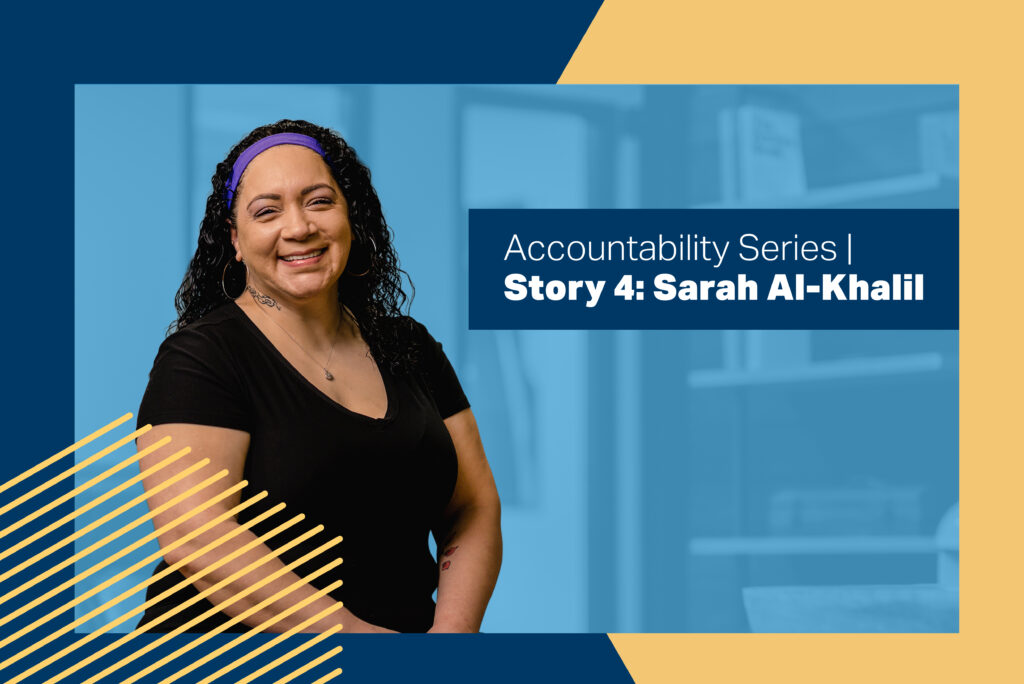
Accountability Series | Story 4: Sarah Al-Khalil
January 15, 2026
In our recent post, Why Accountability Programming Matters Now, our CEO, Amy King, explored the fears and misunderstandings that often surround accountability-based program models—and why they’re needed more than ever. She laid out a clear, ethical framework for building programs that actually help people grow rather than punish them.
But Amy didn’t develop these beliefs in a boardroom; she learned them from people—real people—whose lives were transformed because someone paired structure with compassion at exactly the moment they needed it. Their experiences show that accountability isn’t about control; it’s about connection, stability, and the belief that change is possible.
In this four-part series, we want to share some of those stories with you. They’re powerful reminders that this work isn’t simply about systems or models. It’s about human beings, each with a history, a struggle, and a future worth investing in.
Accountability Series | Story 4: Sarah Al-Khalil: Pallet Team Member
Accountability programming gets a bad rap sometimes, as if it’s just another way to police people who are already struggling. But the best versions of it are the opposite: they’re a steady, practical framework that helps you build a life you can actually keep. I saw that firsthand after completing a 28-day inpatient program and moving into Oxford Housing for a year. Living in a house run by clear rules—with people who shared the same goal—wasn’t restrictive in a negative way. It was crucial. The structure, the expectations, and the community created an environment where sobriety wasn’t just something you hoped for; it was something you practiced every day.
In recovery and reintegration, accountability matters because it reintroduces reality in a supportive way. When addiction has been running the show—especially for people who’ve been homeless or living in survival mode—life can shrink down to one focus: the next fix. Rules, responsibilities, and “the next right thing” stop feeling relevant. Accountability programming helps rebuild that muscle memory. It reminds people what they have to lose, gives them something real to work toward, and reinforces that choices have consequences. Over time, that same structure can restore self-confidence—because each right decision becomes proof that you’re capable of living differently.
For me, the impact was life changing. If it wasn’t for my Oxford House and the accountability built into it, I honestly can’t say I’d be sober today—or that I would’ve avoided relapse. The house gave me structure, guidelines, and support while I relearned how to live without drugs and how to be responsible for my actions again. It shifted my mindset: choices weren’t impulsive or automatic; they were intentional. And knowing others were paying attention—expecting follow-through—gave me even more reason to do the right thing, even on the days when motivation was low.
If someone is concerned about accountability programming, I’d want them to know it’s not designed to focus on punishment—it’s designed to keep people moving forward. The goal is a steady path, not a gotcha moment. And the better programs understand something important: people recover at different paces. Everyone carryies different trauma, different life experiences, and many have spent a long time in survival mode. Accountability can meet people where they are, offering structure and requirements that guide them toward self-sufficiency. Like I’ve come to believe: “Accountability is a core character trait that, if everyone possessed it, would make for a much better world—and when there are accountability programs to support people in gaining that trait, it makes a difference. There’s nothing bad that comes from being held accountable. It helps us live, learn, and most importantly, grow.”
Read parts 1,2, and 3 of this series here: Carolyn's story Joe's story. Dave' story
Read the original blog from our CEO, Why Accountability Programming Matters Now